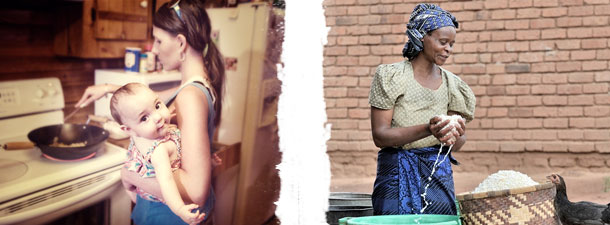
Whenever I’m in a situation that I’m not sure how to handle, or if I’m trying to make a tough decision, I have a rule of thumb I try to maintain: Step back and look at the big picture. I mean the really big picture. I’m a human on this thing called Earth and I try remember a few rules: love people, love God, have fun, and try not to get killed. This comes in handy when I’m stressing about or over-analyzing personal situations or disagreements.
I oftentimes put myself in this big picture point of view when thinking about food and cooking. If I’m ever too hungry (do we really know hungry?) or too stuffed (a little guilty), deciding whether to get a salad or fried chicken (seize your health or seize the day?), or when I start to feel sorry for myself about being “poor”, or not being able to afford the best food around.
Seeing Real Poverty Changes You
It really is hilarious that I’m considered “poor”. I was in a debate on the Facebook wall of TOM’S shoes last week when they announced a new style shoe. Someone complained that Americans need to take care of Americans and stop worrying about everyone else. I hear this all the time, as I’ve been involved in international missions.
Some agreed with her, but most would’ve thrown stones if they could’ve. I calmly responded to said person that if one has that mentality, I’d be willing to bet that they’ve never traveled to a 3rd world country. That they had never actually seen someone dying of hunger right in front of them, or really understood what it takes for some people to get enough dirty water to survive that day.
As I’m sure some of you have, I’ve seen that with my own eyes and lived among it for short periods of time (2 weeks to 1 year) and I can tell you that when you’re in places like that it changes you. It has to change you. Suddenly, you have the ability to step back and look at the big picture of your existence and put your so-called “suffering” into perspective.
1st World Poor
They say that a typical “poor” American, defined by the government has “a car, air conditioning, a refrigerator, a stove, a clothes washer and dryer, and a microwave. He has two color televisions, cable or satellite TV reception, a VCR or DVD player, and a stereo. He is able to obtain medical care. His home is in good repair and is not overcrowded. By his own report, his family is not hungry and he had sufficient funds in the past year to meet his family’s essential needs.”
Seriously? I’d be willing to bet that the vast majority of you reading this may claim to be relatively poor, yet most of you probably have everything above—and if you don’t have it, it’s because you don’t want it (I don’t want cable. I’d watch it too much).
One of my favorite Twitter hashtags is #FirstWorldProblem. I like to use it for posts and comments like I’ve seen in the past week, like, “My apartment’s AC is too cold!” or “I had to buy another fridge and freezer just to hold all the food we bought!”
3rd World Poor
If I had to write the census’ version of a typical “poor” 3rd world citizen, I’d say something like, “has a structurally unsound 1-room shack made out of metal or plastic scraps, has a bucket in the corner for hygiene needs, must bathe and drink from public sources within several miles and typically walks through open sewers in commute. Has one light bulb for entire house and a sheet for his front door. He feeds his family with a few bags of flour or rice. He does not have electricity or running water. He is prone to several life-threatening diseases and does not have easy access or funds to obtain medical care.” #RealWorldProblem
So no, I don’t feel sorry for myself when I have crappy meals. I didn’t feel sorry for myself last night when I had leftover rice, gravy and hot sauce for the 3rd night in a row. We are so caught up in this mentality of needing everything on a silver platter, that we forget how thankful we should be that we have clean water and a roof over our heads.
We should be the healthiest people in the world, yet, we’re probably more malnourished than most people in third world countries because of our eating habits—because we make the wrong food choices. Awww, poor us! We have whole supermarkets we can choose from!
Stop it!
Stop feeling sorry for yourself and calling yourself poor—and especially using that as an excuse to be a slob. You don’t know poor. If you live in a first world country, especially in the United States, you need to remember what you’re capable of and the freedom you have to be financially stable, if not extremely successful.
Do you have any idea how rich you are? Life’s too short to spend it complaining! Be content with what you have and don’t let the world tell you otherwise.


I think this completely misunderstands what it is to be poor in America. Granted, many people who are NOT poor think of themselves as “poor” but when I think of poor, I think of the people I’ve seen in my life who were truly poor.
No car. Bus or walking. Air conditioning is only prevalent in the hot south where it’s required in every apartment. Fridges only if the apartment provides it – many go without and live in hotels paying week to week. Stoves are the same. NO one poor I’ve ever known has had a washer or dryer, they trudge to the nearest laundry mat. Microwaves are a luxury. So is TV and cable.
Even middle class people can barely afford healthcare (If they can!) – the American poor DEFINITELY can’t.
“Home in good repair”? HA! I’ve lived in rented homes with yard wide holes in the floor. Where the bitter winter cold chills you to your bones. Having a home in the first place is a luxury not many poor have. If you own it – it’s probably in poor repair unless you somehow have access to tools and know how to use them. If you’re renting, you better hope your land lord isn’t a slum lord. I’ve seen some bad, bad, living conditions.
In 2015 42.2 million Americans lived in food insecure households. People who miss meals, who don’t know when or where they will get the next one.
Essential needs are NOT met.
I understand the message that if you are not truly poor, be grateful. And perhaps it’s easier to be poor in America with our social support networks and lack of war (though violence in poor neighborhoods is there). But do not pretend there are not poor people in America.
These people are dieing for droping rice
Lived high first world (Santa Barbara) and deep Third World (Indonesia).
First world poor have lots more stuff, lots more opportunities, but also lots more stress and are enslaved to the capitalistic system of debt. From it all, first world poor have lots less happiness.
Third world poor, while nutritionally deficient and exposed to many bad bad chemicals, have happiness everywhere they go, and lots more free time, and tons less stress.
Burning plastics aside (dioxin) I’ll take third world poverty over first world poverty any day. Being a slave to the debt system of the first world a empty zombie existence. Hungry but happy, is at least a half full glass of life. – AB in Santa Barbara and Sabah, Borneo
Thank you for offering this clarity and perspective. I would like to also add this. Growing up in Baltimore I experienced how the inner city poor dealt with poverty in America. I now work in Oklahoma in the medical profession and see how rural poverty presents itself. Two separate populations and cultures of people in America, handle their poverty, very differently. Third world poverty, is truly something every American that finds themselves in hardship, should take an open look at. Attitude and perspective is everything and realizing your abundance as opposed to focusing on ones perceived deprivation should be mind changing.
Fantastic article.!
I just had a heated argument with 2 co-workers while sitting in our office cubicles; after 3 days of no work. I was shocked and could not believe how shocked they were at me describing how poor 3rd world people are. They just could not bring themselves to understand “Real” poverty. Are we as Americans that clueless as to the “True” suffering in the world? “YES.!”
One response was; “You are compering “Apples to Oranges.””
My immediate response was;
“If you consider a starving human in a 3rd world country an Apple, and a starving American an Orange?” “Then you are absolutely right.!”
So sad. . . ; But I have true logic and hope that we will end global hunger within 100 years as politicians are removed; through social evolution, global information via the internet. And plain strong human warrior spirit and action.
LT Enoc Zamora U.S. Army
Thanks for commenting, Enoc!
LOL! Great Article! I wish more people would read this and realize just how greedy, selfish and superficial they are. OH boo-hoo! No Free Health Care bought at other people’s expense! Cry me a river! I don’t have any either before any of you idiots start in with the usual babble. I don’t even have a job! But I am grateful for a roof over my head, food in my belly and clean clothes to wear.
I’ve noted many in America, Canada, and Europe putting each other down in some pathetic attempt to boast about how wonderful they are. How much smarter, more caring, less violent they are. RME
Please! More people should worry more about what THEY CAN DO to help their neighbor then what the Nanny Govt can do for them. We are all Rich Countries and should be ashamed of ourselves when we call ourselves poor.
And the clueless idiot who “called out the author” because no one has ever said anything about running water?! HELLLO! That’s the whole point! People in all three places are forever taking things for granted! That’s the point! DUH!
I think all of these spoiled little brats who live like PARASITES OFF of their Govt should be forced to go to a REAL IMPOVERISHED NATION and see what REAL POVERTY looks like!
Should be noted though, that in the US over 10 percent of the population has no healthcare. Also the cheapest food in the US is often bad quality (filled with chemicals). That being said largely agree with this article, and it certainly applies to European countries with better healthcare and higher quality cheap food (I’d say the US has more choice than Europe but the cheapest choices are much worse….for example I would never find 2% fruit juice in the UK).
I really loved this article. It really puts things in perspective. I am a single mom raising two teenagers and I always feel guilty that I cannot give them the material things that their friends get handed. When the reality of being “poor” in North America is laid out so eloquently like you did here it gave me a sense of comfort because my kids are definitely a lot more fortunate then many others in the world. I have never been a materialistic type of person but it is evident that I need to remember to count my blessings. Thanks for the reminder!
Thank you for the article, refreshing and interesting to think about. You are right, we often do not realise how lucky we are – very #grateful to eat my delicious dinner and relax in my home tonight 🙂
Great article, Ande. I had read that study awhile ago, showing how much worldly goods the “poor” in America own, which includes a lot more stuff than my little family even owns, and I don’t think I’m poor… I had also recently been considering the difference between being poor vs. not being able to afford everything I want. BIG difference. I think that the word poor in America has become shorthand for “not as much as that other guy has.”
Of course there’s always exceptions… some extremely rural parts of places like West Virginia do have families living in overcrowded homes or trailers with little or no access to water and very little access to adequate food. Not third world conditions, for sure, but it doesn’t mean their suffering and their need isn’t real. So there’s my two cents 🙂
Thanks for the comment! It’s great to discuss this frankly. Maybe I’m just naive, but I would like for someone to show me where these starving people are who literally have no access to food or water. Where are they?
Nobody that I saw said “literally have no access to food or water.” Those words are purely yours, and unfair.
But if you want to see people in America who are starving and have limited access to clean water, you can visit select sections of Appalachia, many reservations, rural Mississippi, Alabama, and Louisiana, and some areas in the great plains. Those, at least, I have seen directly.
As hard as it may be for many of us to believe, not everyone in America has access to electric power or basic phone services.
I hear you, though I don’t think it’s unfair for me to say “no food or water”. Anyway, I don’t want to get into it, frankly- but this goes back to my original statement that what we consider “poor” in America looks differently than what Africans consider poor. I’m not saying we don’t have poor Americans. I grew up in NC and I see it. But I’ve also been to Africa and it. is. different.
while i do agree that we should help all and not just focus on americans, i don’t think the plight of the poor in america should be downplayed, because to be honest, i doubt they’re the ones complaining about the #firstworldproblems that appear on that timeline. (btw, love that twitter as well) especially with the wealth gap in america growing more and more, there are still places in america where people only have access to dirty water and are starving, and in a place that has the infrastructure and resources for that to be impossible? that’s almost as big a moral outcry to me… but again, i’m not saying one is over the other, i just think they are both issues that need to be addressed. but thanks for this post. its does seem like the more we have, the more we tend to complain… which is sad.